Wednesday, November 2, 2011

Cam Newton could reshape the QB position


In sports, I’ve always been a sucker for when the going is good, it’s going to get better. In the middle of John Maine's scoreless streak a few years back, I believed he was going to be the anchor of the Mets rotation. I am convinced that Aaron Maybin has turned a figurative corner like he continues to turn actual ones, and that Toney Douglas can eventually be the premiere point guard on a basketball team. Which is why I may be jumping in front of this train instead of on it; but as of right now, I legitimately think it’s just a matter of two or three years until Cam Newton is the most dominant player in the NFL.
In the first 8 weeks of this NFL season, Newton has shown that all of his otherworldly athletic gifts translate directly to the pros with no exchange rate. He has the arm to make almost any throw on the field, the legs to run away from people, and the strength to run at them. With Manning and Brady, you marvel at their accuracy, and with Vick you marvel at his raw talent. But Cam Newton has the ability to dominate every phase of the game he chooses like no quarterback ever has.
What I didn't like about Newton coming out of college was that you really couldn't find anyone to compare him to. In many ways, the NFL is a think "outside the box" league in terms of personnel (look at how tight ends have gotten smaller and faster, starting with Tony Gonzalez).
But not with quarterbacks, where the idea of a dual threat QB has failed over and over again. Vince Young? Not enough arm strength, even worse accuracy. Michael Vick? More than enough arm strength, but not big enough to absorb getting T-boned by a linebacker. And it goes back further: Andre Ware, Eric Crouch, Tim Tebow, the list goes on and on. While they bring certain unique skills to the table, they lack other very necessary ones to be successful in the NFL.
But what it looks like with Newton is a Hakeem Olajuwon type of situation. Olajuwon's skillset for a center was something that was completely unique. There hasn't been anyone else that large with his foot work, or quick hands (ball handling and steals). Just like there hasn't been an athlete the size and speed of Cam Newton able to not only chuck the ball downfield, but capable of grasping a complex offense and thriving in it (61% completion rate through his first 8 games). 
From what I've seen so far, the most accurate description of him is a cross of Donavan McNabb and Ben Roethlisberger. He's Roethlisberger's height - but about ten pounds bigger - and with a slightly lower completion percentage in his rookie season. But, he already has more rushing yards through 8 weeks (319) than Roethlisberger has ever had in a season. Which would then make Newton more like McNabb, who routinely averaged 5 yards per carry during a season, and who could at times take over a game on the ground or in the air.
 But McNabb didn't have a 60% passing season until his 5th year in the league, and more importantly, was constantly criticized for his inability to show up in the big moment. For all of the physical talent that McNabb had, he was missing the most important component: he never had the mental part completely down, and was prone to doubting himself and coming apart at the seams at the worst possible times. In short, he was soft.
 By all indications, Newton is not built that way. If anything, he was so overconfident in the pre-draft process that it was mistaken for extreme narcissism. What NFL scouts wanted to hear is how much he knew he'd need to adjust how his style of play from college the NFL. What they got was a kid talking about how he wanted to be an icon before he even broke a huddle.
After torching the SEC (the equivalent of a league between D1 college football and the NFL) he's still the same size or larger than most linebackers, and faster than practically all of them. DeAngelo Hall admitted last week what I already assumed: defensive backs don't know how to tackle him, and don't really want to figure it out. With most quarterbacks, there’s always a tool missing, even if it’s not apparent. Tom Brady and Peyton Manning are sitting ducks when the pocket breaks down. Michael Vick is dynamic, just like Steve Young was, but bounces around like a pinball when he’s hit. Cam Newton has all the tools in the toolbox, and then a few more just for show.
 What Newton is, is a completely mold breaking athlete comparable to LeBron or early 90’s Mike Tyson. He's hard to tackle and confident like Roethlisberger, with McNabb's foot speed, and Bo Jackson on the goal line (3rd in the NFL with 7 rushing TDs). He’s Daunte Culpepper with actual work ethic, a clean bill of health, and experience in big games. If he pans out, you will see 10 more Drew Brees’ before you see another Cam Newton. If the Panthers surround him with a decent team, they’ll win divisions. If they surround him with a good team, they’ll win Super Bowl’s, and there’s not a doubt in my mind about it. 

Friday, October 21, 2011

Thoughts on the NBA lockout


           This lockout passed ridiculous well before David Stern stayed home from school sick yesterday. Obviously, there are major differences between the players and the owners in terms of what the revenue split should be, the length of a max contract, and a number of other issues. But it’s as if both sides haven’t even looked up from the monumental hole they’re digging to see whether anyone cares if they pull themselves out.   
            It’s common knowledge that the only league that could weather a prolonged lockout (especially in this economic climate) is the NFL. The rabid demand that this country has for football, combined with only two days a week to watch it make for huge numbers in every area that it touches. Football is America’s game now and its national popularity is unrivaled.
           The NBA’s national popularity is certainly going to take a hit from this lockout, but only a jab at worst. But regional popularity, the support of individual teams, is what fuels the national presence. And that’s where the NBA is going to get hammered.
           People are fans of a team first and foremost, not the NBA as a whole. I watch the NBA because I am a Knicks fan, not vice versa. I usually make it to 2 or 3 games at most a year, and would try and make it to more if I had the money. MSG is appointment TV on game nights regardless of what else is on, regardless of whether the point guard has been Chauncey Billups or Chris Duhon. 
          The finals were one of the most highly rated ever because of how regionally polarizing they were. Dallas and Miami fans obviously tuned it because their team (and it disgusts me that the Heat are “Miami’s team” when in every sport outside of football, Miami has possibly the worst fans in sports) had a chance to win it.
          I watched it for two reasons; of course to see a high level of basketball. But what superseded that was that I only wanted to see it from one team. I was OK with watching the best player in the whole league fail miraculously because of he screwed MY team in the offseason. I’m sure plenty of Chicago fans felt the same way, and all of Cleveland probably huddled around one of the two functioning TV sets left there, voodoo dolls clutched firmly in their hands.
            Plenty of people that watched the Finals this year weren’t that concerned with seeing a high quality of basketball. They just wanted to see LeBron (or for Toronto fans Chris Bosh) fail because of a team allegiance. And I'm sure this extends to different fan bases. For example, during the Magic-Lakers finals, Celtics fans probably shared the same sentiments about Kobe Bryant. 
            If or when the NBA comes back this season, there are 10 or so cities that will welcome it back as if it never left, and about 5 more who will take a while to warm up, but return in full force within a month.
           But the NBA is going to lose major ground is in swing cities where basketball and hockey were on level footing in terms of regional support before the lockout. Cities where all the fans that live and die with the NBA sit in one section, adrift in a sea of casual fans who come to games because of the atmosphere of the event, and not any particular tie to the team. 
            The obvious cities are the ones far enough north that the ponds freeze. Minneapolis, where the Wild outdrew the Timberwolves by an average of 3,000 fans per home game last year, would certainly qualify. But looking into it further, this makes sense in Minnesota, a town that isn’t exactly steeped in basketball tradition. Moreover, the Wild have regularly given their fans something to cheer for, while the T-Wolves haven’t sniffed a winning season since Garnett left town.
            The trend is reaching even farther south into more important cities. I’ve lived in the Washington D.C. area for long enough to know that people down there could really give a shit less about the Wizards.
            Even with a potential franchise savior in John Wall, the Verizon Center is first and foremost where the Capitals play. Back in 2007, the last time the Wizards advanced to the playoffs, was the last time that basketball was the main draw. The Wizards had an average home attendance of 17,962, and the Capitals averaged a meager 15,472.
            Since then, the tables have turned completely. Last year the Wizards averaged slightly under 17,000 fans per home game, good enough to fill 83.2 % of the Verizon Center. While the Caps, who have built an exciting team around possibly the best player in the sport, averaged 18,397 fans per game, which filled the Verizon Center to capacity.
            But obviously the issue is not just about walk-up attendance this day in age. The interest in a team can be gauged just as accurately by TV ratings. According to Sports Business Journal last year, the Capitals finished the year with a 1.8 average to the Wizards 1.15, that’s a 57% gap between the two teams. What’s more, the Caps appear to be trending heavily upward (the 1.8 was up 12% from 2009), while the Wizards essentially numbers have essentially stagnated for the past few years.
            Judging by these two numbers, it’s safe to say that despite being south of the Mason-Dixon line, Washington is pre-eminently a hockey town. And it's obvious just by going to games; the Verizon Center comes to life when the Capitals are there. There are more people, making more noise, who care much more about the outcome of the game
            Now, with the NBA not showing any interest in maintaining the small fan base that they have in Washington, those numbers are likely to skew even more towards the Caps, even when the Wizards eventually slog back into the Verizon Center with their subpar squad.
            And Washington is just one of several cities. Take Boston for example. If basketball comes back in December, Boston fans will be coming back to a team on the downside of its apex, without a bench presence capable of effectively spelling the well-aged starters.
            Or, they could continue to support the reigning Stanley Cup Champions stocked to the brim with 27-and-under talent in their quest for a very plausible repeat. In Boston, the Red Sox run the town with the flavor of the week always determined by who has the winning ingredients. I defy any Boston sports fan to tell me that the Celtics have a better chance of winning a championship than the Bruins this year, so why wouldn’t Boston fans place their faith and attention with the surer bet?
            What Philadelphia fans are going to turn their attention back to a middle of the road 76ers team, when they have the option to watch a serious contender with the Flyers? The same argument can be made for Detroit. The Charlotte Bobcats, despite playing in a city almost double the size of their hockey competitor, did not outdraw the Carolina Hurricanes last year.
            And as this lockout continues to drag on and on, even the die hard fans get tired of being treated like shit. With the Jets mustering all the offensive firepower of a gas station sparkler, I need the distraction that basketball usually provides, but there’s nothing to follow right now. No news about how the rookies are acclimating because they have nothing to acclimate to. The normally non-stop gossip of the free agent rumor mill is non-existent.
            The only NBA news trickling out has been copy and pasted day to day for the last few months; the owners and players obstinately sticking to their guns on the same 4 or 5 issues, and having less successful lock-in’s than the bloods and the crips did in South Park. It’s fucking depressing.
            So my two options are to delve deeply into politics for the 6 days in between Jets games, or watch hockey. Needless to say, the precious little I know about the Islanders is much more than I ever thought I would. With the most intriguing college basketball season in years still weeks away, the Islanders are all that's on tap right now.
             I never originally latched onto hockey for a number of reasons (one of which being that I never played it, which I think is tied very heavily to following a sport. I skate like a baby giraffe walks because my freakishly tall and thin dimensions aren’t meant to function in skates. Stop making it look so fucking easy Zdeno Chara).
            But the primary one was that I never thought it would catch up in popularity with the NBA. And I don’t think the NHL would ever have a chance of catching up if owners and the players could decide how to tie the NBA’s shoes.
            It’s evident in every conversation I have, or Facebook status that I see from an NBA fan that the lock out is wearing very thin. It’s becoming difficult to rationalize caring so much about the return of a sport that so transparently could give a damn less about its fans.
            The complete lack of urgency or progress during this lockout tells me one thing. At one point during the meetings, the fans have inevitably been mentioned, and completely dismissed with the notion of "don't worry, they'll be back, let's continue banging our heads against a wall."
            And I will be back, because I can't cut ties with a team that I've been following since I was 4. Because after sitting through 10 years of Keith Van Horn for Tim Thomas, the Curry-Randolph front-court tandem swallowing the whole pre-game buffet and then the ball, and simply having to deal with Isiah Thomas’ existence within the organization, I feel like the Knicks owe me something. But somehow, I think I’m going to be looking back at plenty of people wondering where the hell I’m going. 

Thursday, October 13, 2011

3 changes the Jets should make


After the last 2 years, it’s safe to say at 2-3, the Jets are a team that could and should be playing much better. There were a few casualties from 2010 to 2011, but the overall impact of those losses shouldn’t have reduced the product on the field to an offense incapable of moving the ball, and a defense as good at stopping the run as the offense is at sustaining it. This isn't Kansas City where a team took advantage of an easy schedule, or Pittsburgh where the offensive line is a shell of what it used to be. I still firmly believe this is a playoff team that has trouble hearing the starting gun for the season, and for most games.  
Realistically, the general anger towards this team is the result of one road loss. If the Jets had hit .333 on their road swing instead of coming back to New Jersey with a big fat goose egg, there would still be some worries, but losses in Baltimore and New England are certainly forgivable. But because of an upset loss in Oakland, and the subsequent offensive debacle in Baltimore (albeit without the services of by far their best offensive player) there has been a media backlash two years in the waiting.
There aren’t many teams capable of digging themselves out of a hole in the AFC East. The Jets are one of the teams with the talent and favorable schedule to do so. Combine that with the Bills being average the rest of the way (and a defense that is 30th in the NFL will tend to produce those results), and the season is far from over. If the Jets make these three changes, I don't see how they finish any worse than 10-6. 

1)   Make sure Collin Baxter and Vlad Ducasse never see the field again:

            The offensive line looked night and day better with its most talented player back on the field Sunday, but Mangold’s return doesn’t address a huge depth issue. The first two blockers off the bench are more than likely Collin Baxter and Vlad Ducasse, who collectively will be paying of Sanchez’s chiropractic bills for the rest of the season.
There is no way that two players on the free agent market aren’t markedly better than those two human sandbags. Damien Woody said this morning that he would at least answer a call from the Jets, and that’s something definitely worth looking into. Woody’s pass blocking skills have diminished over the pass few years, but he’s still a strong run blocker that helped pave the way for the Jets dominating running game the last two years.
If Woody decides he’s done for good, there are still veterans out there right now (Shaun O’Hara, Nick Kaczur) who would not only come relatively cheap, but would be a huge upgrade at this point in the season. They were obviously cut for a reason, but I think the chief issue with them was and is durability. Neither of them is capable of lasting for an entire training camp and a 16 game season as a starter. However, if the Jets were to pick up one of those guys during the bye week, it would immediately provide much better offensive line depth and insurance against another injury to a starter.

2)   Keep the laundry off the field

Although the Jets have played within the guidelines in the majority of their games, this weekend yellow flags rained from the skies. Were it not for the 89 penalty yards that the Jets racked up, there’s a decent chance that they could have pulled off the upset in Foxboro.
Anybody who’s watched this team play for the past two years will admit that it’s not the most dynamic. But while the Jets have been loud and aggressive off the field, they have usually been relatively disciplined on it. In 2010, the Jets averaged 5.9 penalties per game for 52 yards over 20 games. During this three game losing streak, they’re averaging 8 penalties per game for 73 yards. The Jets played three games total that met those criteria last year (atleast 8 penalties for atleast 73 yards).
The Jets don’t need to be choir boys; the new two-hand touch rules don’t jibe with how they play defense. But back breaking penalties like the one in the first quarter on 3rd and 26 when New England was on their own 12 last week are going to do two things. They're going to make it more difficult for an already average offense to score points, and they're going to put too much pressure on the defense to sustain a very high level of play. 

3)   Make LT the starter at running back

It’s crazy to look on the roster and see LaDainian Tomlinson, who might be the best running back of the past 15 years, listed at #2 on the depth chart. Now obviously, he’s not in the Hall of Fame form that he was as a Charger. But that shouldn’t make people blind to the idea that Shonn Greene is a better option as the starter
I really liked Shonn Greene when the Jets drafted him out of Iowa. He was and still is a powerful straight ahead runner with a gift for wearing down defenses. But for a number of reasons, I don’t think he’ll ever be able to sustain the success he had in the 2009 playoffs. The biggest issue being that he’s borderline useless as a receiver.
 The Jets are trying to force feed him passes this year (he has 12 catches in 5 games when he only had 16 all of last year), but even that’s not working. Among the 29 running backs with at least 10 catches this year, Greene ranks 26th in yards per reception (5.9). LT on the other hand ranks 2nd behind Ray Rice, averaging slightly more than 14 yards every time he catches a pass.
Although LT’s speed and agility haven’t aged that well, hands have a longer shelf life. And Tomlinson has some of the best hands at running back in the whole league. So this is not an issue of trusting an average back to run crisp routes and catch tough passes, Tomlinson has proven his whole career that he’s capable of that. The ball needs to come his way more.
The idea that Greene is a non-threat in the passing game is what allows defenses to load up against the run, or blitz when they see him on the field. Because he’s not capable of breaking a short pass for a long gain, opposing teams can sell out against an up the middle run, and unsurprisingly Greene hasn’t averaged 4 yards per carry in any game this year. There is no element of surprise with someone with such a one-note skill set.
The other side of the issue comes with the offense. If Tomlinson is in, and Sanchez sees a jail break blitz coming, a viable option is to audible to an empty look, and get a favorable matchup with a linebacker or safety trying to cover LT on a passing route. I’d be willing to bet anything that any empty sets are quickly discarded when Greene gets on the field. 
In the past two years, the Jets have lost eight total games. In six of those games, Tomlinson has caught two or fewer passes, including two total catches for six yards in the losses against Baltimore and New England. By contrast, they are 5-2 when he has 5 or more catches in a game. When Tomlinson has carried the ball 15 or more times in a game, the Jets are 7-2 since last year. Even just as a runner, he had a higher yards per carry than Greene last year (4.17 to 4.14).
The system that worked was to use LT until he tired out, and then have a fresh Greene at the end of the season. I have no idea why this team has deviated from that philosophy, when just about every metric says that when LT is at his best, he’s a much more effective option than Greene.

Thursday, September 29, 2011

Ravens vs. Jets Preview


Considering Maryland took a week off last week, I think I’ll take a week off from writing about them. See if they can handle Towson at home, and then I’ll try to reattach the axles to the Maryland bandwagon
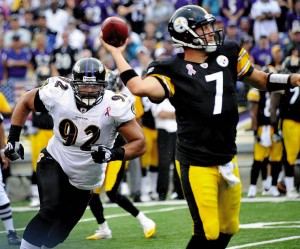
First and foremost I’m a New York Jets fan, and they’ll be playing about two blocks from my house on Sunday. So let’s get to breaking down a game between two of the top contenders in the AFC behind the standard of excellence, the Buffalo Bills.


Why the Ravens should win this game:

In their two wins, the Ravens have been dominant, outscoring Pittsburgh and St. Louis by a combined 72-14. Obviously, the Steelers win is going to continue to look better as Pittsburgh continues to round into form, while the Rams win could depreciate for the opposite reason. 
They’ve looked like a better team in the first three weeks than the Jets. Even their lone loss doesn’t look as bad, with the Titans playing like a legitimate contender until Kenny Britt’s leg exploded last week. If I had to break it down position by position, the only spots that I could definitively give to the Jets would be defensive backs, and offensive line if Nick Mangold is healthy this week.
Specifically, The Ravens offensive personnel could be a particularly difficult matchup for the Jets if Cam Cameron plays his cards right. Looking into DVOA, the Jets are unsurprisingly the best in the league at holding #1 receivers in check, but from there it becomes somewhat murky. The 8th in league rank vs. #2 receivers could take a hit this week considering that either A) Cromartie will be playing with a bruised lung, or B) Kyle Wilson will be face a major step up in competition.
The weakness of the Jets pass defense lies in their coverage of tight ends (25th in DVOA). Jason Witten had 6 catches for 110 yards in week 1, and even Kevin Boss had a 28-yard catch last week. The Jets two starters at safety are undersized (Jim Leonhard), and shaky in coverage (Eric Smith) respectably. Even if Brodney Pool makes the occasional appearance, this week is the perfect time for the Ravens to unleash Dickson and Pitta over the middle.
Obviously the most obvious plan of attack for the Ravens would be pounding it out on the ground after seeing what happened last week against Oakland. But bear in mind two things: Darren McFadden is possibly the best running back in the NFL at this point, and this is almost the same defense that shut down Ray Rice last year (21 carries, 43 yards). As a Jets fan, I have to think that the strategy will be to keep the best player (Rice) from making a huge impact, and making Flacco win this game.  If he stays away from Revis, and works on Cromartie and the tight ends, he should have an efficient, productive day on the way to a Ravens win.


Why the Jets should win this game:

            Flacco and Sanchez aren’t separated by much this year. They’re 12th and 13th respectively in DVOA and DVAR, which measures how much better they’ve been than an average NFL quarterback. Flacco has more TD’s and fewer picks, but so far this season, Sanchez’s completion percentage is demonstrably higher (62.5 to 54.1). That number tells me that Flacco has dodged a few bullets this year with his inaccuracy, and an opportunistic Jets defense could jump on those (see the Jacksonville game). 
Flacco has been outstanding out of the gates this year, going a combined 17/28 for 295 yards and 4 TD in 3 first quarters. But as you can guess by looking at his season stats, that means a disproportionate amount of Flacco’s production has come early in games. Although the Ravens have essentially put away two of their three games before halftime, Flacco is still only a 50% passer (22/44) with a TD and an INT in second halves this year.
Sanchez has been completely the opposite, completing 20/33 passes in 3 fourth quarters this year, and throwing 4 of his 6 touchdowns after halftime. What this all comes down to is that Sanchez has crunch time reps, and it’s accurate to say that he excels late in games. Could Flacco if he was put in the same situation? I don’t necessarily think so, considering he hasn’t thrown a 4th quarter touchdown since Week 10 of last year. So if this game is close late, I think the advantage swings heavily towards New York.
To win Sanchez needs to establish Holmes and Burress. The Ravens should do a very good job of taking away Dustin Keller and LaDainian Tomlinson (3rd in DVOA vs. tight ends, 5th in DVOA vs. running backs). The Ravens struggle on the outside of their defense, where Cary Williams and LaDarius Webb are two subpar corners who have had a lot of trouble containing big time receivers like Kenny Britt and Mike Wallace. Holmes has shown in the past two years that he’s capable of going off for a big game against an overmatched corner.
So I expect the Ravens to shift the coverage towards him, leaving Plaxico Burress in a lot of single coverage over on the other side. Mark my words, if Plax has a big day (say 6 catches for 80 yards and a TD), the Jets will win this game. With him producing, the Ravens can disguise coverages as much as they want, the Jets will just have too much firepower against an average Ravens secondary.

Ravens win if

Dickson and Pitta get over 120 yards combined.
Ray Rice gets over 150 total yards and a TD
Plaxico Burress has under 60 yards receiving
Flacco’s completion percentage over 60%

Jets win if:

The game is within 7 points going into the 4th quarter
Plaxico Burress has over 80 yards and a TD
LaDainian Tomlinson over 100 all-purpose yards and a TD
Ravens score 14 points or less in the first half

Wednesday, September 21, 2011

AFC Power Rankings #1: New England Patriots


What makes them good:
It may be a small sample size, but this could be the best, most electric passing offense ever seen. The only thing that I can think of that compares is the Rams during their "Greatest Show on Turf" era, but even they would be impressed with a team averaging 463 yards over their first two games. Everything about the Patriots attack is efficient beyond words, and there really isn’t a blueprint around for how to stop it, outside of getting heavy pressure on Brady without blitzing him.
Possibly the most brilliant thing about the offense is how it has been constructed. Instead of focusing on wide receivers, who are generally overpaid and can easily be double-teamed by safeties if there is only one major threat, the Patriots focused on taking those safeties away with game breaking tight ends.
Aaron Hernandez and Rob Gronkowski are two of the top 5 tight ends in the league right now, and they’re playing on the same team. Between them, they have 5 touchdowns and 6 catches of 20+ yards. Not only can defenses not double team New England’s receivers, they more than likely have to allocate one of the better players in their secondary to at least one of the tight ends.
Because of this, New England’s receivers benefit from routinely seeing single coverage, and occasionally getting major mismatches. Wes Welker is 3rd in the league in receiving, and even more telling, Deion Branch is 6th. The same Deion Branch who was little more than a warm body in a cold city in Seattle is now a lethal receiving threat in New England. And that’s because he’s treated as the 4th biggest receiving threat on the team.
            Of course, the success of this system probably falls half to those who designed it, and half to those who implement it. By that rationale, about 75% percent of the credit belongs to Tom Brady. As opposed to Peyton Manning, Tom Brady has shown no signs of slowing down. Practically every passing statistic worth keeping track of has “T. Brady” at the top of the list, with the lone exception of completion percentage where he trails Matt Schaub – by 0.1%.
            Brady is one of maybe three players (along with Drew Brees, Aaron Rodgers) that could be put onto any team right now, and make them into not only a playoffs contender, but a Super Bowl hopeful. With him at the helm, and a healthy offensive line, the Patriots will be able to walk out of almost any shootout with no blood on their shirts.


Weaknesses:
Last year, the average quarterback against the Patriots completed 63.5% of their passes for 259 yards per game and an 81.2 quarterback rating. The Patriots defense had 36 sacks on the year and 25 interceptions. When comparing those numbers to the pass defenses of the past 8 Super Bowl champions, the Patriots defense ranked last or second to last in every category except for sacks (6th), and interceptions (3rd). This year, the Pats are again struggling to hold opposing quarterbacks in check.
Just last week, Phillip Rivers racked up 378 yards on 29/40 passing with 2 touchdowns and 2 picks. Had he not lost Malcolm Floyd during the game, the damage could have been even more substantial. A week earlier, Chad Henne – the same quarterback Dolphins fans booed during the preseason – conjured up memories of Dan Marino at Sun Life Stadium. He completed 30-49 passes for 419 yards, 2 touchdowns, and a late interception.
Now, it would be biased not to mention that Henne had a similarly monster day against the Jets early last year (26-44, 353 yards, 2 TD, INT). However, the Jets were missing a top 3 defensive player in football. What the Patriots have right now is what they will be working with the rest of the season. This is essentially the same defense that allowed 250+ yards in 8 of their first 12 games last year, and allowed 21+ points in 6 of those games.
They did meld into a borderline fantastic unit down the stretch last year, holding 4 of 5 opponents to 7 points or less to end the regular season. But they went back to struggling in the playoffs when they weren’t able to force a turnover on the Jets offense, and allowed Mark Sanchez to amass his 2nd best quarterback rating as a pro.
Albert Haynesworth was supposed to shore this defense up, and create the pressure on the quarterback that the team was so sorely lacking last year. Well, for a 6’6” 350 lb man, Haynesworth has done an impressive job of being almost invisible.
Of the 22 plays he was in against the Chargers, he was single blocked 15 times, and his stat sheet is completely blank. No tackles for loss, no quarterback hurries, not even a drawn holding penalty. Vince Wilfork has been a one man band one the defensive line, and without having to worry about Haynesworth, teams are free to double team him.
            As I said earlier, having Brady means that this team will win 9 out of 10 shootouts that they’re in. But there will be those one or two games this season that Brady has a tough day. Last year he had a bad game against Cleveland (almost completely inconsequential), and against the Jets in the playoffs (the worst possible time). If the defense can improve, the Patriots will be blowing teams off the field. But if they have to keep putting up 28 points to win games, they just have to hope that their bad offensive performances come at convenient times for them. 

AFC Power Rankings #2: New York Jets


What makes them good: 
A suffocating, and for the first time, healthy defense. Obviously health in NFL is extremely moment-to-moment, but as of right now, the Jets might have their strongest defensive unit that Rex Ryan has ever had. The first three quarters against Dallas were touch and go, but since the Cowboys’ first possession of the 4th, the Jets have been downright dominant.
After a fortuitous fumble forced on Tony Romo, the Dallas offense gained 40 yards total on their proceeding four possessions, which culminated in a blocked punt, punt, interception, and fumble respectively. Overall, it was an uneven performance, but as has become the Jets trademark, they harmonized in the waning moments.
I don’t want to get too excited about last week’s performance in Jacksonville, because of how incredibly stagnant and one-noted the Jaguars offensive “attack” is. I expected a dominant win last win for the Jets, and I wasn’t disappointed. But, there is a point to be made for exactly how dominant the Jets were. After all, the Jaguars did win their first game against a Titans team that is becoming a trendy underdog pick after their upset of Week 1 Super Bowl favorite Baltimore.
The Jets made the Jaguars look like an unpracticed high school team. The bowling ball with the MJD initials managed to get his (as he inevitably does), but after an error-free week 1, Luke McCown might have thrown one good pass all day. It was called back by a holding penalty. After what many considered to be a down year in 2010, last week’s performance showed they type of dominance that the Jets exhibited in their first year under Rex.
Muhammad Wilkerson needs to continue his improvement on the defensive line, and Mike Pettine needs to find the correct mix of what safeties should be on the field at what times, but those are the only two problems left to solve. The outside pass rusher that fans were clamoring for in the offseason has materialized in the form of a finally healthy Calvin Pace. The run defense has been stout as always, and the best cornerback in the league looks as good as ever when quarterbacks have accepted the gambit of throwing at him.
Antonio Cromartie was beaten twice for touchdowns in Week 1, and he’s certainly far from perfect. But most teams don’t have one receiver as talented as Miles Austin and Dez Bryant, let alone two. Cromartie’s perfect coverage on the Austin touchdown was overshadowed by a flawless pass by Romo, and a phenomenal job on the receiving end by Austin. He usually does get beaten on more than one occasion during a game, but he’s one of the few #2 cornerbacks capable of the exceptional play, and he’s the most dangerous player on the Jets with the ball in his hands.


Where they are struggling:

            The offense is in the midst of an identity crisis. It unquestionably belongs to Brian Schottenheimer’s at this point, with most of the handoffs ending with the ball still in Mark Sanchez’s hands. Since Nick Mangold will be on the bench for at least the next two weeks, it should probably stay that way. But this team has made its hay the past few years hammering away at defensive lines with top notch blocking. The abundance of talent up front has allowed average running backs to consistently gouge 5 to 6 yards per carry every season.
            Unfortunately, with the injury to Mangold, what was a talent thin offensive line is now emaciated. D’Brickashaw Ferguson and Brandon Moore are both still among the elite at their respective positions, but their top-level talent looks misplaced among their shockingly average peers.
Matt Slauson was a nice story last year at left guard, but even if he maximizes his ability, he’ll never be a left guard on the level of Alan Faneca or Pete Kendall who came before him. Wayne Hunter has served only as a flattened speed bump in the first two games, not even charging cover to pass rushers, while only barely stemming their momentum on the way to full force collisions with Mark Sanchez. He’s been bad enough that there has been talk of replacing him with Vlad Ducasse, which is like going to a gunfight with a plastic knife instead of a metal one.
            And then there is Sanchez. This is after all his third year. The year that the honeymoon is not only over, but all of the pictures from it are gone. As always, he’s looked very uneven. His box score against Dallas has a gaudy number in the yardage column, but the mistakes were frighteningly amateur, as were his 2 early interceptions in the Jacksonville game.
And none of the mistakes have been because of bad luck with tipped passes or drops. All three interceptions have come when Sanchez was sitting in a comfortably sized pocket, and completely misreading the coverage. A fourth should have come on the last drive against Dallas where the immortal Alan Ball almost jumped a terrible throw, but had it fall through his hands. Sanchez may never be an elite fantasy quarterback, but he needs to remember to be a steady real one.
When the Patriots won the Super Bowl in 2003, the biggest keys for them were that they had a very good offensive line, an even better defense, and a quarterback who didn’t take them out of a game. In Tom Brady’s third year as a starter, he threw for 3,620 yards (a number not unreachable for Sanchez who threw for 3,291 yards in 2010) 23 touchdowns and 12 interceptions.
Brady didn’t have an interception in 12 out of 19 games, and was intercepted twice or more in only four (two of which were the Patriots only losses). He also completed 60.2 % of his passes, which is probably the biggest stat for a quarterback in my opinion. Huge yardage numbers are always fun to watch, but you only need ten yards to pick up a first down and keep your opponents defense on the field.
The point here is, is that Sanchez needs to realize that, just like a great pitcher, some days he’s not going to have his best stuff. Great players know how to work around that and still be effective. If Sanchez can hit the same baseline numbers that Brady hit in 2003, there’s no reason this team can’t win a Super Bowl with a healthy, dominant defense. 

AFC Power Rankings #3: Baltimore Ravens


            What makes them good:
 A defense that can win games for them every week. In every sport, an offense can be explosive but it’s inconsistent. Because defense relies more heavily on effort and less on luck, a great one will only vary so much from week to week.
The Ravens possess a borderline ideal mixture of young talent, and veteran knowledge. Terrell Suggs has set up camp in the top 3 NFL sack leaders, and Haloti Ngata is the best defensive lineman in football. Meanwhile, Ed Reed and Ray Lewis are playing like they’re half their age, but with game smarts that most defensive coordinators would covet.
What sets this team apart on offense is Ray Rice. Although Rice isn’t the traditional between the tackles 25 carry a game type back of yesteryear, he is an incredibly effective hybrid in the mold of Maurice Jones-Drew, Matt Forte, and previously Marshall Faulk. Rice’s pass catching ability is probably the envy of some of the wide receivers in Baltimore, and allows the Ravens to extend their running game from sideline to sideline with screen passes and flat routes. There aren’t many teams with dominant defenses in this league, and the Ravens may be the only one with a top 5 running back on the other side of the ball.
The offensive line, which had previously been a point of concern, now looks to be steady. It ranks 7th in the AFC in adjusted sack rate on Football Outsiders, and has only allowed 4 sacks this year, and with the talent in place, it will only get better as the unit melds.
Bryant McKinnie has curbed his apparently monumental appetite, and looked like an All-Pro left tackle in the Week 1 matchup against the Steelers. That has allowed Michael Oher to shift back to right tackle, where despite occasionally being overly anxious, he has morphed into an extremely effective presence. Matt Birk’s lingering neck issues haven’t yet been a factor, and his skill and leadership are undeniable. Joe Flacco will not have many issues with being protected this year.  


Where they struggle:
Although the Ravens addressed plenty of things in this offseason, they still didn’t plug the hole at cornerback that Chris McCallister left when he retired. Jimmy Smith may eventually be the answer, but considering he's not only a rookie, but also injured it's safe to say that this won't be the year he determines that. For now, Ed Reed is still covering up mistakes in the secondary like the Wolf in Pulp Fiction, but he’s getting long in the tooth, and it’s tough to clean up the mistakes when he doesn’t know where they will be.
Last week, this secondary revived the argument that Matt Hasselbeck can be a viable NFL starting quarterback, mainly because they made Kenny Britt look like the second coming of Randy Moss. Although the safety position features significant depth with Bernard Pollard and Tom Zbikowski, neither of those two is especially adept in pass coverage.
Point blank, if Cary Williams is covering the other team’s best receiver, you’re going to need to give him help. The Ravens allowed a 100+ yard receiver in only four of their 17 games last year. This year both Mike Wallace and Kenny Britt have reached that mark. In a league where spread formations are now commonplace for almost every team, the Ravens don’t have the secondary necessary to shut down high powered passing attacks like New England, San Diego, and to a lesser extent Pittsburgh (when they don’t turn the ball over 7 times). 
Lastly, the passing offense has yet to completely come together. If Eli Manning was able to guide a team to a Super Bowl, Joe Flacco is more than capable of accomplishing the same feat. But he needs to do a better job of avoiding the ugly games, like last week in Tennessee.
If there’s one suggestion I could make to the Ravens passing offense, it would be to adopt a similar strategy to the one that the Patriots use. This team can stretch the field vertically, but they would be more effective doing it with their tight ends instead of their receivers. Anquan Boldin’s strength is obviously not his speed, and Lee Evans is not the savior that some Baltimore fans have depicted him to be.
Instead, the Ravens should look towards the middle of the field where they have something akin to “Patriots-Lite” with Ed Dickson and Dennis Pitta. They are being used some right now as evidenced by their numbers in the Steelers game. It’s time to use them more. Dickson has the speed to toast linebackers, and Pitta has a set of hands that are comparable to Jason Witten’s.
Joe Flacco has an absolute howitzer for an arm, but that doesn’t mean it needs to be employed exclusively on wayward deep balls. If the Ravens offense can simply recognize where their best matchups are (Rice against linebackers and the tight ends against safeties), and exploit them, the offense has the potential to be one of the more dangerous ones in the AFC.